
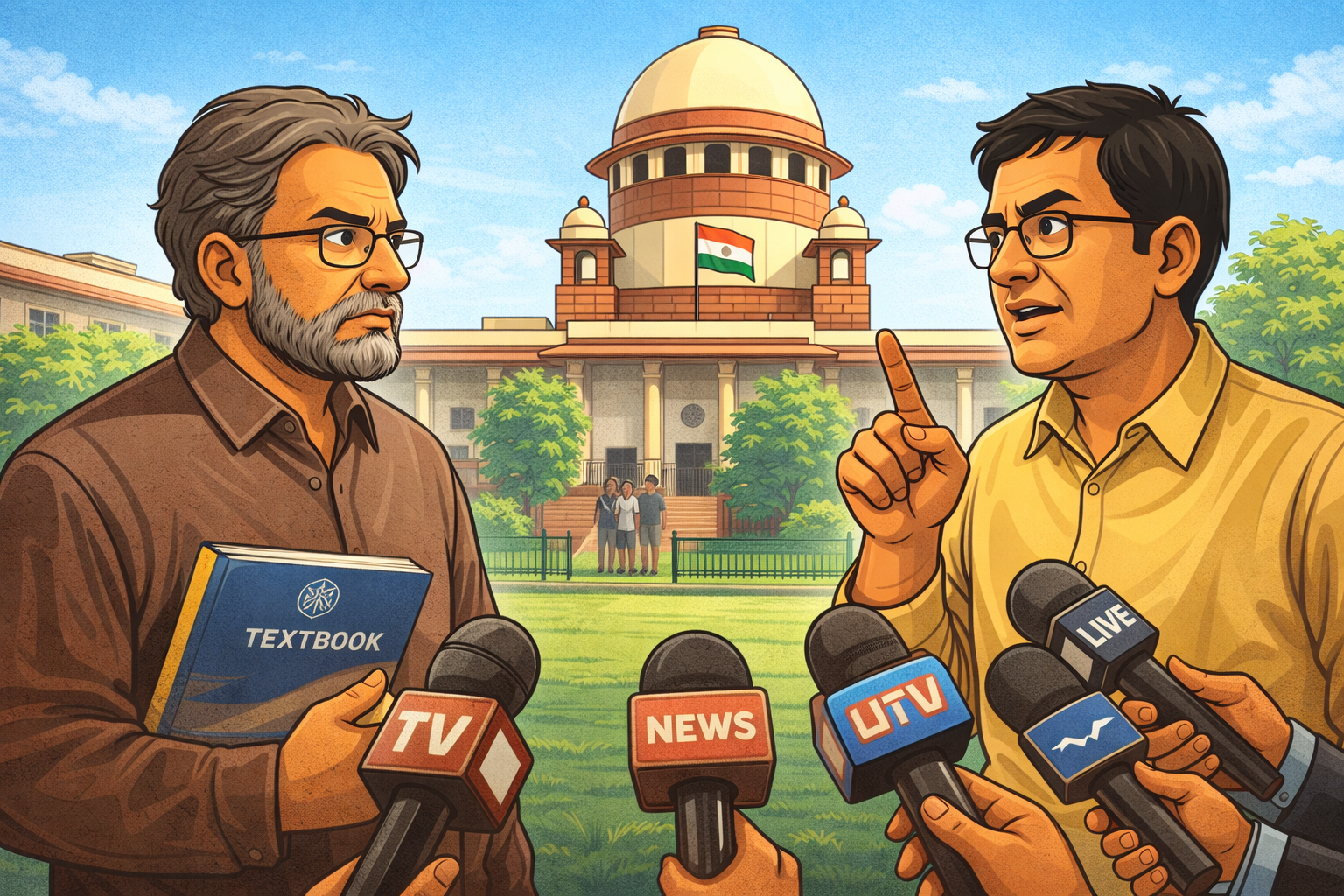
The NCERT textbook controversy has reached the Supreme Court of India, where three experts have challenged observations made against them over a Class VIII textbook chapter on the judiciary published by NCERT.
This NCERT textbook controversy raises critical questions about academic freedom, judicial dignity, and the limits of court intervention in educational content.
Background of the NCERT Textbook Controversy
The issue arose after concerns were raised regarding certain portions of the NCERT textbook “Exploring Society: India and Beyond (Class 8, Vol. 2)”, particularly a section dealing with the judiciary. Reports suggested that parts of the chapter referred to “corruption in the judiciary,” triggering serious objections.
Taking suo motu cognisance, the Supreme Court observed that the content undermined the dignity of the judiciary. As a result:
- The textbook was withdrawn from circulation
- NCERT issued an apology
- The Court directed that the concerned experts should not be associated with curriculum development
Experts Challenge the Action
In response, the three experts have now filed applications before the Court, seeking to clarify the process behind drafting the chapter.
Senior advocates representing them argued that:
- The work was a collective academic exercise
- No single individual was solely responsible for the content
- The authors are respected professionals, not casual contributors
The matter was mentioned before a Bench led by CJI Surya Kant and Justice Joymalya Bagchi, which noted that the applications would be listed after procedural defects are rectified.
Supreme Court’s Earlier Directions
In its earlier orders, the Court had taken a strict view, stating that:
- Content in educational material must uphold institutional dignity
- Authors responsible for questionable content should not be involved in future curriculum processes
This marked a rare instance of the judiciary directly intervening in academic content creation.
Formation of Expert Committee
Following the controversy, a high-level committee has been constituted to review and finalize the curriculum. It includes eminent members such as:
- Justice Indu Malhotra
- KK Venugopal
The committee has been tasked with:
- Aligning textbook content with constitutional values
- Reviewing the revised chapter
- Ensuring accuracy and balance in legal education
Legal and Academic Implications
This case raises important questions at the intersection of judicial oversight and academic freedom:
- Can courts intervene in textbook content?
- Where should the line be drawn between criticism and institutional respect?
- Should experts be penalized without a detailed hearing?
The outcome may set a precedent for how educational content is regulated in India.
Conclusion
The NCERT textbook controversy highlights the delicate balance between freedom of academic expression and protection of institutional integrity. While the Supreme Court’s concerns about maintaining respect for the judiciary are significant, the experts’ plea underscores the need for fair hearing and due process.
As the matter proceeds, its final outcome will likely shape future discourse on education policy, judicial sensitivity, and the role of experts in curriculum development.