
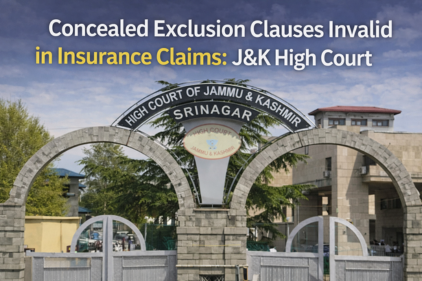
The concealed exclusion clause insurance dispute before the Jammu & Kashmir and Ladakh High Court highlights a critical consumer protection issue, whether insurers can deny claims based on exclusions that were never clearly disclosed to policyholders
The ruling was delivered in National Insurance Company Limited v. Mala Bashir, where the High Court dismissed an appeal filed by the insurer against an order directing it to compensate a house owner for flood damage.
Insurer Cannot Rely on Concealed Exclusion Clause in Insurance Policy
A Division Bench comprising Justice Sanjeev Kumar and Justice Sanjay Parihar underscored that while an insured is obligated to disclose material facts relating to the risk, insurers carry an equally heavy responsibility to clearly notify, explain, and highlight exclusion clauses in insurance contracts.
The Court observed that any contractual clause allowing an insurer to escape liability, while retaining the benefit of premium payments, must be strictly scrutinised, particularly when consumer rights are affected.
“Once it is shown that the contract contains a clause which, if enforced, would allow the insurer to escape liability while benefiting from the consumer’s payment of premium, such a clause must be struck down as unfair,” the Court held.
It further ruled that a clause negating the essential purpose of the contract is void and unenforceable under consumer protection principles.
Background of the Case
The dispute arose from damage caused to a residential house during the September 2014 floods in Kashmir. The house owner had insured the property under a Standard Fire and Special Perils Policy issued by National Insurance Company Limited.
However, the insurer repudiated the claim, asserting that the policy excluded STFI perils (Storm, Tempest, Flood and Inundation).
The Jammu & Kashmir Consumer Redressal Commission, Srinagar, found the insurer partly negligent. While acknowledging the presence of an endorsement excluding STFI perils, the Commission reduced the assessed loss by 25% and directed the insurer to pay compensation of ₹4.76 lakh. 3(c) as a separate provision?” the Court asked.
High Court on “Take It or Leave It” Insurance Contracts
Hearing the insurer’s appeal, the High Court highlighted that insurance policies are standard-form contracts, drafted unilaterally by insurers, leaving consumers with no scope for negotiation.
“Courts have consistently treated such contracts as contracts of adhesion, inherently tilted in favour of insurers,” the Court noted.
It further observed that Standard Fire and Special Perils Policies ordinarily cover natural calamities, including storm, cyclone, flood, and inundation, as reflected in Clause VI of the insurer’s own policy document.
Legitimate Expectations of Consumers
The Court found that the very title of the policy, Standard Fire and Special Perils Policy, would lead an ordinary consumer to reasonably believe that it covered natural calamities such as floods.
“A consumer would legitimately infer that the policy covers all specified perils, including those now sought to be excluded,” the Court said.
In the absence of the proposal form or any corroborative evidence, the insurer failed to prove that the exclusion clause was fairly disclosed or adequately explained to the insured.
The Bench also noted that the acronym “STFI” was not even spelt out in the policy, making it unreasonable to presume that the insured understood the scope or impact of the exclusion.
Concealed Exclusions Cannot Defeat Consumer Rights
Reinforcing consumer protection principles, the Court held that when a policy is styled as comprehensive and covering special perils, an insurer cannot rely on hidden or obscure exclusions to defeat legitimate claims.
“The insured cannot be presumed to have understood the exclusion,” the Court concluded.
Finding no illegality in the Consumer Commission’s order, the High Court dismissed the insurer’s appeal through its judgment dated December 04, 2025.
Conclusion
This ruling reaffirms that insurance companies must act transparently and in good faith, especially when dealing with consumers who have no bargaining power. Exclusion clauses that are buried, vaguely worded, or inadequately disclosed cannot be used as tools to deny genuine claims.
The judgment is a significant reminder that consumer welfare and fairness remain central to insurance jurisprudence, and insurers cannot benefit from ambiguity at the cost of policyholders.