
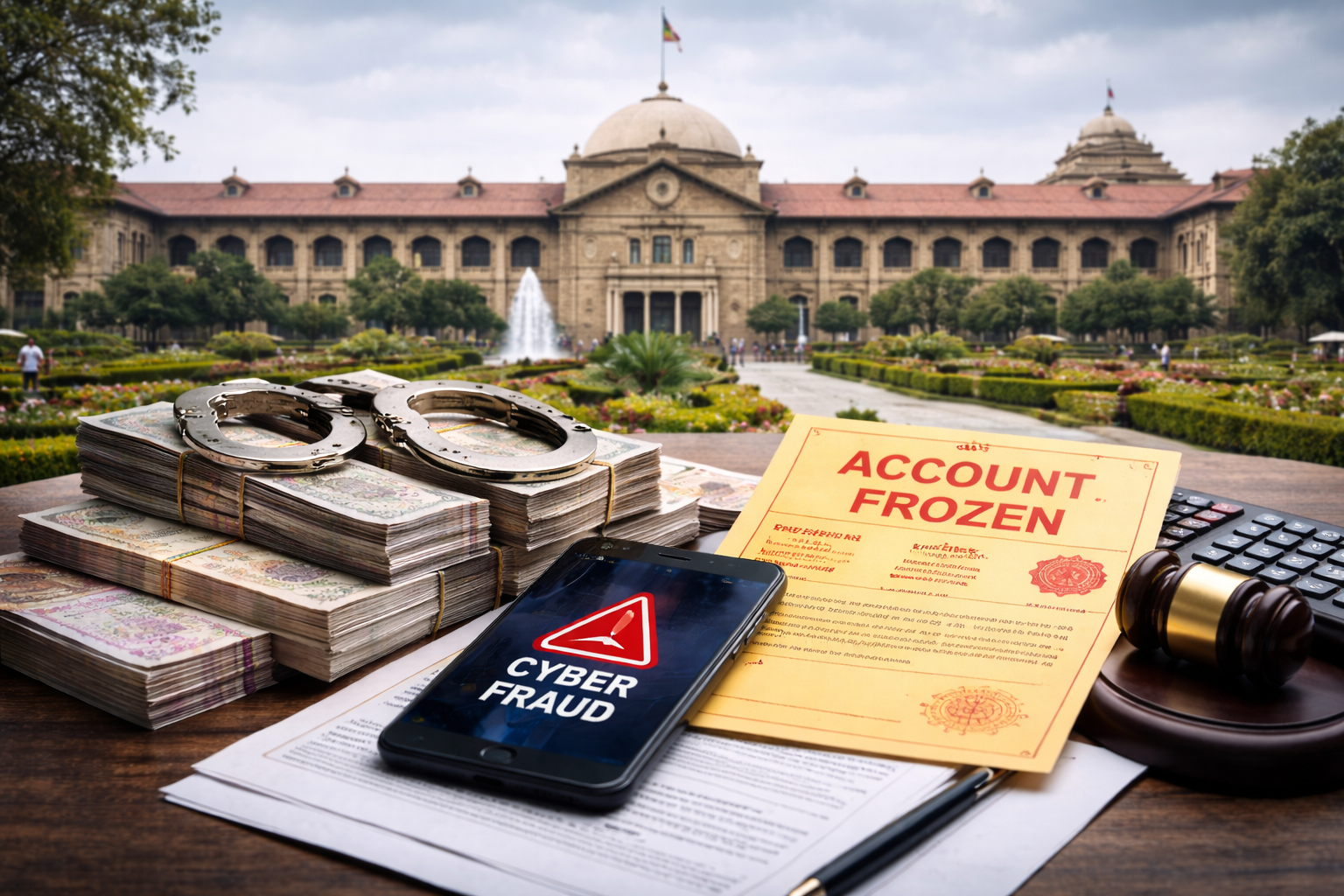
The Allahabad High Court freezing of bank accounts ruling has brought significant clarity to the procedure adopted by investigating agencies in cyber fraud cases. The Court has emphasized that there cannot be any discrimination or high-handedness while freezing bank accounts and that such actions must strictly follow the procedure established by law.
In Tarkeswar Tiwari v State of Uttar Pradesh and 6 Others, a Division Bench of Justice Atul Sreedharan and Justice Siddharth Nandan is examining whether authorities are following due process while directing banks to freeze accounts linked to cyber fraud investigations.
Court Concerned Over Lack of Transparency
The Court observed:
“Various writ petitions before us disclose that banks have freezed the bank accounts and when the account holders approach them, they are only informed that the accounts have been freezed on letter either by the Police authorities or the Cyber Crime. However, the said letters till date have not been brought on record in spite of the specific instructions on the previous dates.”
The Court expressed concern that the freezing communications relied upon by banks have not been placed on record despite earlier directions.
Procedural Anomalies Under Scrutiny
The petitioner, Greevas Job Panakkal, served as Company Secretary at Traco Cable Company Limited, a State PWhile courts have previously examined the powers of investigating agencies under Section 106 of the Bharatiya Nagarik Suraksha Sanhita (BNSS), the present batch of petitions focuses specifically on procedural safeguards and fairness in freezing bank accounts.
The Bench observed that the issue requires clarity to address procedural anomalies and ensure that:
- Bank account holders can retain trust in the banking system.
- Banks act strictly in accordance with law.
- There is no element of discrimination or high-handedness.
The Court emphasized that freezing of accounts must strictly follow a procedure prescribed by law and cannot be arbitrary.
Directions to the Union Government
Significantly, the Court held that refusal to accept resignation in such circumstances would amount to “bonded labIn an order dated February 10, the Court recorded that the Union government has undertaken to address key concerns by filing an affidavit. The Court directed clarity on the following issues:
1. Legal Contingency for Freezing Accounts
The specific statutory provision, rules, or regulations under which an account can be frozen must be clearly stated.
2. Specific Amount to Be Frozen
The order directing freezing must specify the exact amount to be frozen.
If no amount is indicated, banks may seek clarification before freezing, and the freeze should extend only to the specified amount.
3. Mandatory Intimation Within 24 Hours
Banks must intimate the account holder within 24 hours of receiving communication to freeze the account, through their registered address or preferred mode of communication.
4. Standard Operating Protocol
A Standard Operating Protocol dated January 2, 2026, must be placed on record, clearly outlining the procedure to be followed before freezing bank accounts.
Importance of the Ruling
The Court underlined that freezing of bank accounts directly impacts individuals’ access to their hard-earned money. Therefore, such action must be:
- Transparent
- Lawful
- Non-discriminatory
- Free from arbitrariness
The Bench clarified that only a procedure prescribed by law can justify such interference.
Next Date of Hearing
The matter is scheduled to be heard next on February 26.
Appearance
- Advocates Zaheer Asgharm Syed Ahmad Faizan and Malik Juned Ahad appeared for the petitioners.
- Senior Counsel SP Singh appeared for the Union of India.
- Advocates Swati Agarwal Srivastava and Abhishek Ahuja appeared for the respondents.