
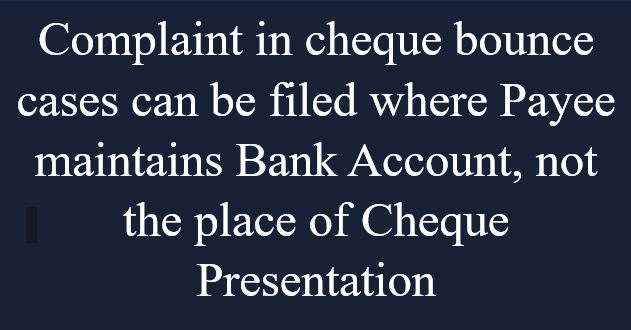
In its ruling dated November 28, 2025 (2025 INSC 1362), the Supreme Court of India overturned earlier rulings such as Yogesh Upadhyay v. Atlanta Ltd. as per incuriam and held that only the court whose jurisdiction the payee’s or holder’s banking account (home branch) is situated has exclusive territorial jurisdiction to try complaints under Section 138 of the Negotiable Instruments Act, 1881 (NI Act). The 2015 Amendment Act’s Section 142(2)(a) and its Explanation, which clearly establish jurisdiction at the payee’s bank branch to stop forum shopping and shield the accused from harassment, are the source of this clarification. In order to resolve jurisdictional disputes that arose after 2015, the bench of Justices J.B. Pardiwala and R. Mahadevan instructed all High Courts to adopt this interpretation.
CASE BACKGROUND
On March 23, 2014, HEG Ltd. (the complainant/payee) received a cheque for Rs. 19,94,996 from Balaji Industries Ltd. (the accused company and directors), drawn on a Bhopal branch bank, in response to an invoice. HEG Ltd. filed a Section 138 complaint with the Metropolitan Magistrate (MM), Kolkata, where HEG’s account was located, after the cheque bounced. However, on July 28, 2016, the MM returned the case, citing lack of jurisdiction following the 2015 Amendment. The accused subsequently filed transfer petitions to return to Kolkata after HEG refiled before the Judicial Magistrate First Class (JMFC), Bhopal (drawee bank location), which accepted jurisdiction despite accused objections under CrPC. Sessions Court Bhopal confirmed this.
The Court examined a batch of similar petitions, focusing on whether drawee bank courts retain jurisdiction post-2015 and transferability after evidence recording under Section 145 begins.
SECTION 142 (2) (a) NI ACT EXPLAINED
Section 142(2)(a), inserted by the Negotiable Instruments (Amendment) Act, 2015 (effective April 15, 2018), states: “Notwithstanding anything contained in sub-section (2) of section 326 and section 475 of the Code of Criminal Procedure, 1973 (2 of 1974), all offences under section 138 shall be tried by a Judicial Magistrate First Class or by a Metropolitan Magistrate, and the jurisdiction for trying those cases shall be determined in accordance with the provisions of Chapter XIII of that Code, unless otherwise provided in this Code.”
Explanation to Section 142(2)(a): “For the purposes of this sub-section, the ‘relevant local jurisdiction’ for trying offences under section 138 shall be the jurisdiction where the bank account of the payee or holder in due course, as the case may be, is maintained.” This overrides general CrPC jurisdiction (Sections 177-189), mandating payee’s home branch court as the sole forum, filling the vacuum left by Dashrath Rupsingh Rathod v. State of Maharashtra (2014) which had favoured drawee banks. The Court emphasized that the Explanation clarifies, not expands, jurisdiction—drawee bank courts lack competence post-amendment.
COURT’S DECISION AND DIRECTIONS
The Supreme Court framed two main legal issues:
- Whether the MM, Kolkata had jurisdiction under Section 138 post the 2015 amendment?
- Whether the complaint should be transferred back to the MM, Kolkata in light of the evidence already recorded before the 2015 amendment?
On Jurisdiction the Court stated:
“It is as clear as a noon day that the jurisdiction to try a complaint filed under Section 138 in respect of a cheque delivered for collection through an account, i.e., an account payee cheque, is vested in the court within whose local jurisdiction the branch of the bank in which the payee maintains the account, i.e., the payee’s home branch, is situated.”
Therefore, the MM, Kolkata did not have jurisdiction under the 2015 Amendment, as the complainant maintained its account in Bhopal.
On Transfer:
The court ruled in favour of the Petitioners regarding the transfer. The Court cited Dashrath Rupsingh Rathod, which had mandated that in order to “obviate and eradicate any legal complications,” matters that had reached the stage of Section 145(2) (recording of evidence) should stay in the court where they were pending.
The Court held: “In such view of the matter, we are of the considered opinion that allowing the parties to contest the complaint afresh before the JMFC, Bhopal would amount to a procedural impropriety that may prove to be detrimental to the case of the accused.”
CONCLUSION
By firmly establishing Section 138 NI Act jurisdiction at the payee’s home bank branch, the Supreme Court’s decision in Jai Balaji Industries Ltd. v. HEG Ltd. (2025 INSC 1362) fulfils the 2015 Amendment’s promise of ease, justice, and efficiency in check bounce litigation. The ruling eliminates forum shopping, protects accused from undue hardship, and gives payees accessible local remedies by strictly adhering to statutory interpretation principles—literal reading of the Explanation, non-obstante override of CrPC, and per incuriam overruling of conflicting precedents. This restores the NI Act’s function as a prompt commercial dispute resolution mechanism. A significant advancement in criminal-commercial jurisprudence will result from this payee-centric clarity, which would expedite millions of cases, lower judicial backlogs, and increase confidence in India’s negotiable instruments ecosystem.