
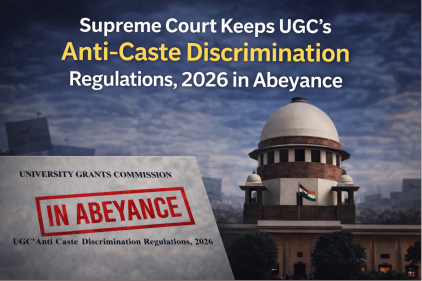
The UGC anti caste discrimination regulations notified in January 2026 have been kept in abeyance by the Supreme Court after serious concerns were raised regarding exclusion of general category students and potential violation of Article 14 of the Constitution.
The Regulations, notified by the UGC on January 13, 2026, apply to all higher educational institutions across India and aim to prevent discrimination in campuses. However, they have been challenged before the top court for allegedly excluding general category students from the grievance redressal mechanism.
Supreme Court Examines UGC Anti Caste Discrimination Regulations
A Bench comprising Chief Justice of India Surya Kant and Justice Joymalya Bagchi expressed serious reservations about the wording and structure of the Regulations.
“If we don’t intervene, it will lead to dangerous impact, will divide the society and will have grave impact,” the Court observed.
The Bench further noted that the Regulations would require examination by an expert committee, particularly due to the vague language used in defining discrimination.
“Prima facie, we say that the language of the regulation is vague and experts need to look into it so that it is not exploited,” the Court said.
Accordingly, the Court issued notice to the UGC and the Central Government and ordered that the Regulations remain in abeyance for now.
Conflict Between Definitions in the Regulations
The Court specifically flagged the inconsistency between Section 3(c) and Section 3(e) of the Regulations.
- Section 3(c) defines “caste-based discrimination” as discrimination only against Scheduled Castes, Scheduled Tribes, and Other Backward Classes.
- Section 3(e) defines “discrimination” broadly to include unfair or biased treatment against any stakeholder, on grounds including religion, race, caste, gender, place of birth, or disability.
The Bench questioned the necessity of a narrow definition under Section 3(c) when Section 3(e) already provides a wider, inclusive definition.
“When Section 3(e) subsumes everything, why bring Section 3(c) as a separate provision?” the Court asked.
Petitioners’ Arguments
The petitioners contended that the Regulations are exclusionary and discriminatory, as they deny grievance redressal protection to students not belonging to SC, ST, or OBC categories.
Advocate Vishnu Jain, appearing for the petitioners, argued that Section 3(c) violates Article 14 of the Constitution.
“Discrimination cannot be assumed to exist only against one segment. If discrimination is already defined broadly, excluding general category students is impermissible,” he submitted.
The petitioners further argued that the framework could encourage unchecked hostility against non-reserved categories, defeating the objective of equity.
Court’s Broader Concerns
The Bench lamented that even after 75 years of independence, caste-based and regional discrimination continues to persist in society.
The CJI remarked that such regulatory frameworks risk pushing society towards regression rather than inclusion, drawing parallels with historical segregation practices.
Justice Bagchi added that while Article 15(4) allows special provisions for disadvantaged classes, progressive legislation must not create new forms of discrimination.
What the Court Ordered
- Notice issued to UGC and the Central Government
- Regulations to remain in abeyance
- Petitions to be tagged with similar pending matters
- Matter to be heard next on March 19
Conclusion
The Supreme Court’s decision underscores the delicate balance required in framing anti-discrimination policies. While the objective of promoting equity in higher education is undisputed, the Court has emphasized that laws must be inclusive, precise, and non-divisive.
The final outcome of the case could significantly shape how discrimination complaints are addressed within India’s higher education institutions.