
Maintenance Income Verification: Supreme Court Questions ₹9,000 Salary Claim

Maintenance income verification took centre stage as the Supreme Court questioned a husband’s claim of earning ₹9,000 per month in a ₹12,000 alimony dispute. The Court indicated it may summon the employer to verify the salary details, reinforcing stricter scrutiny in maintenance cases.
High Court Contempt Jurisdiction Clarified by Supreme Court
The Supreme Court Collegium has introduced a new policy allowing judges set to become Chief Justices of High Courts to be transferred in advance of upcoming vacancies. The move aims to ensure smoother leadership transitions, administrative continuity, and uninterrupted judicial functioning.
Supreme Court Collegium Introduces Early Transfer Policy for Incoming High Court Chief Justices
The Chief Justice early transfer policy introduced by the Supreme Court Collegium} allows incoming High Court Chief Justices to be transferred in advance to ensure smooth leadership transition and uninterrupted judicial administration.
Banks Becoming Liability in Digital Arrest Scams: Supreme Court Issues Strong Warning

The Supreme Court has warned that banks are becoming a liability in digital arrest scams, directing RBI, CBI and Centre to act swiftly to prevent fraud.
Supreme Court Challenge to BNSS Allowing Judges in Prosecution Roles
A lawyer has moved the Supreme Court challenging BNSS provisions that allow serving or retired judges to head state prosecution offices, alleging violation of judicial independence and separation of powers.
BNSS Arrest Notice Mandatory Before Arrest: Supreme Court
The Supreme Court held that arrest is not mandatory in offences punishable up to seven years and that police must ordinarily issue a notice under Section 35(3) of the BNSS before making an arrest.
Supreme Court Keeps UGC’s Anti-Caste Discrimination Regulations, 2026 in Abeyance
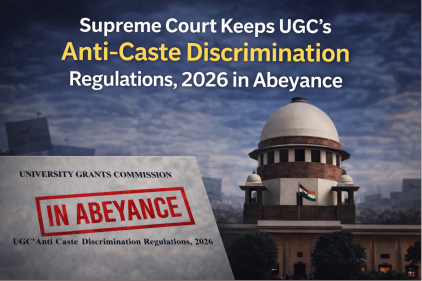
The Supreme Court has kept the UGC Anti Caste Discrimination Regulations, 2026 in abeyance, citing vague definitions and exclusion of general category students from grievance redressal.
SUPREME COURT CLEARS JURISDICTION IN SECTION 138 NI ACT CASES- A LANDMARK CLARIFICATION
In a landmark judgment dated November 28, 2025 (2025 INSC 1362), the Supreme Court of India clarified that exclusive jurisdiction in cheque bounce cases under Section 138 NI Act lies with the court where the payee’s or holder’s bank account (home branch) is maintained. Overruling conflicting precedents, the Court emphasized that the 2015 Amendment’s Section 142(2)(a) and its Explanation were designed to prevent forum shopping and protect accused persons from harassment. By directing High Courts to uniformly adopt this interpretation, the ruling restores certainty, streamlines litigation, and strengthens the NI Act’s role as a swift commercial dispute resolution mechanism.