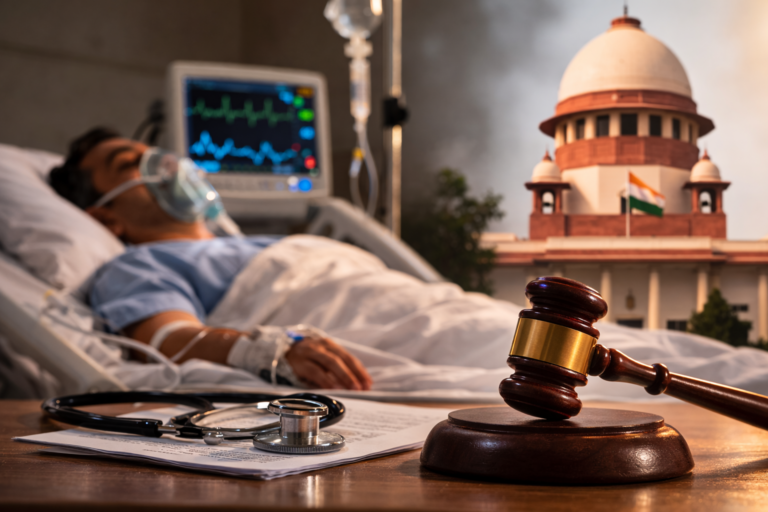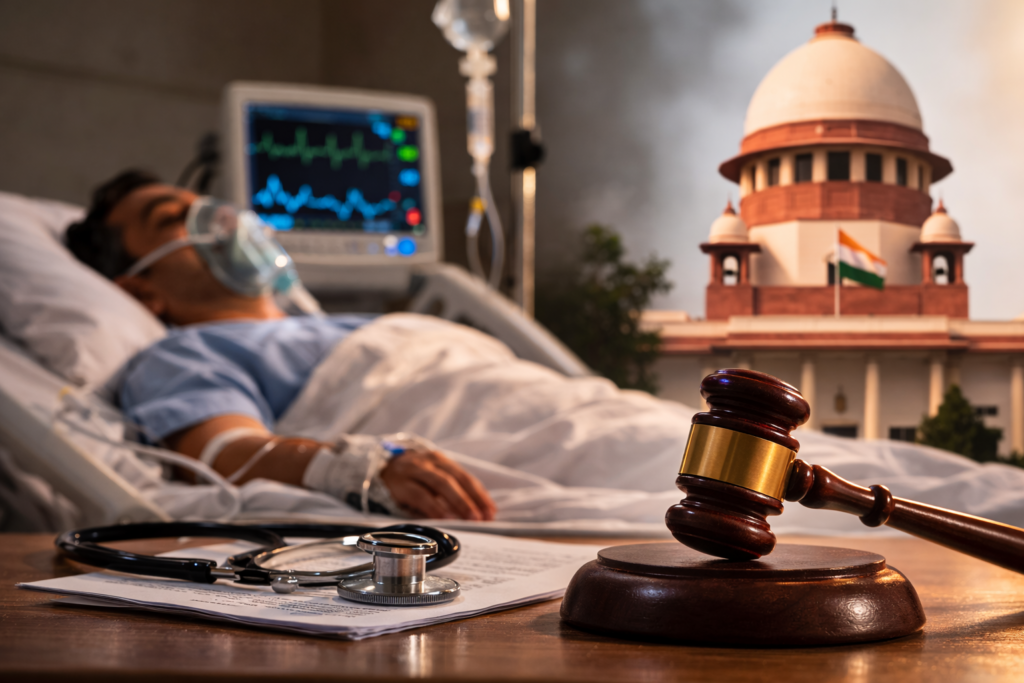

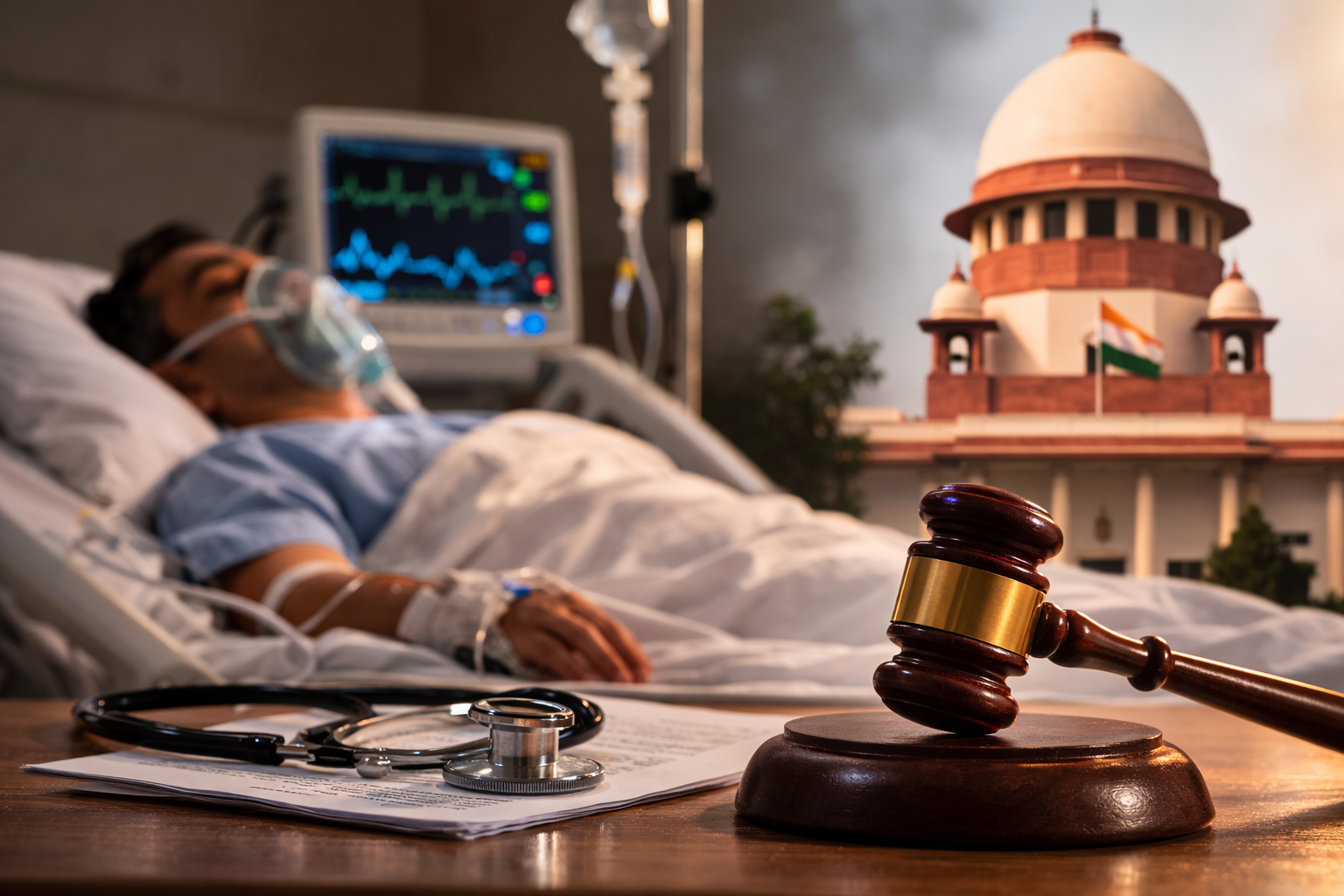
Passive euthanasia Supreme Court India became the focus of a major ruling when the Supreme Court of India permitted withdrawal of life-sustaining treatment for a 31-year-old man who has remained in a permanent vegetative state since 2013 following a severe accident.
The Bench of Justices JB Pardiwala and KV Viswanathan allowed the request filed by the patient’s family, observing that his condition has shown no medical improvement for over a decade. The Court held that the medical board may exercise its discretion regarding withdrawal of life support in accordance with the guidelines laid down in the landmark 2018 Common Cause judgment.
Passive Euthanasia India Case Background
Harish Rana suffered a grievous accident in August 2013 when he fell from the fourth floor of his paying guest accommodation. The fall resulted in a severe traumatic brain injury, leaving him in a permanent vegetative state.
According to medical records placed before the Court, Rana experiences sleep–wake cycles but shows no meaningful interaction with the outside world. He has remained completely dependent on caregivers for all activities and has been receiving clinically assisted nutrition and hydration through a PEG tube for several years.
His family approached the courts seeking permission to withdraw life-sustaining treatment, arguing that his condition is irreversible and that continuing treatment serves no meaningful medical purpose.
Earlier Proceedings Before the Delhi High Court
The family had earlier approached the Delhi High Court seeking the constitution of a medical board to evaluate Rana’s condition and determine whether withdrawal of treatment would be permissible.
However, the High Court declined the request. It observed that the patient was not on mechanical life support and was capable of sustaining basic bodily functions without external ventilatory support. Since he was not considered terminally ill, the Court held that the conditions for passive euthanasia were not satisfied.
The parents subsequently challenged the High Court’s decision before the Supreme Court.
Supreme Court’s Observations
While examining the case, the Supreme Court noted that Rana’s medical condition had remained unchanged for more than a decade and that he continues to remain in a persistent vegetative state with no realistic chance of recovery.
The Bench observed that although he exhibits sleep–wake cycles, there is no meaningful interaction or awareness. The patient remains entirely dependent on others for self-care and basic activities.
Considering these circumstances, the Court held that it would be appropriate to allow the medical board to exercise its clinical judgment regarding withdrawal of treatment.
Reliance on the Common Cause Judgment
The Court clarified that the decision must follow the framework laid down in the landmark 2018 judgment in Common Cause v. Union of India. In that ruling, a Constitution Bench of the Supreme Court recognised passive euthanasia and allowed withdrawal of life-sustaining treatment under specific safeguards.
The 2018 judgment also recognised living wills and advance directives, allowing individuals to express their wishes regarding medical treatment in the event they become incapable of making decisions.
The Supreme Court had held in that case that the right to life under Article 21 of the Constitution includes the right to live with dignity, which also encompasses dignity in the process of dying for terminally ill patients or persons in a permanent vegetative state.
A Rare Individual Application of Passive Euthanasia
Legal observers note that this may be among the first instances where the Supreme Court has allowed passive euthanasia in an individual case by applying the principles laid down in the 2018 Common Cause judgment.
The Court emphasised that the final decision regarding withdrawal of life support should be taken by a competent medical board after assessing the patient’s condition in accordance with the established guidelines.
Significance of the Judgment
The ruling highlights the judiciary’s attempt to balance medical ethics, constitutional rights and humanitarian considerations in cases involving patients with irreversible medical conditions.
By allowing the medical board to decide on withdrawal of treatment, the Court reaffirmed that the right to life under Article 21 also includes the right to die with dignity in appropriate circumstances.
The decision is expected to serve as an important reference for future cases involving patients in permanent vegetative states where families seek legal clarity on end-of-life medical decisions.