


Employee Stock Option Plans (ESOPs) have become one of the most effective tools for attracting, motivating, and retaining talent, especially in startups, growth-stage companies, and listed entities. When structured and managed correctly, ESOPs align employee interests with business growth and shareholder value. When done poorly, they can create legal risk, tax inefficiencies, dilution concerns, and employee dissatisfaction.
ESOP advisory and management is not just about granting options. It is a continuous process involving strategic design, legal compliance, valuation, communication, administration, and post-exercise governance. This article explains ESOPs in detail and outlines how professional ESOP advisory helps companies design and manage plans that actually work.
What is an ESOP?
An Employee Stock Option Plan allows eligible employees to acquire shares of the company at a predetermined price after completing a defined vesting period. ESOPs are commonly used to reward long-term contribution, improve retention, and create a sense of ownership among employees.
ESOPs typically include:
- A grant of options
- A vesting schedule
- An exercise price
- An exercise period
- Conditions for lapse, termination, or exist
Why ESOPs matter for Businesses Today
ESOPs are no longer limited to large corporates. They are widely used by startups, NBFCs, fintechs, IT companies, and listed entities, key business benefits-
- Retains high-performing employees without immediate cash outflow
- Aligns employee goals with company growth
- Builds long-term commitment and ownership mind set
- Helps attract top talent in competitive markets
- Supports succession planning and leadership continuity
The Need for ESOP Advisory
Many companies rush into ESOPs using generic templates or borrowed structures. This often leads to:
- Non-compliance with Companies Act or SEBI regulations
- Tax disputes for employees
- Confusion during exits or funding rounds
- Shareholder dilution conflicts
- Poor employee understanding and low perceived value
- An ESOP advisor bridges the gap between business goals, legal requirements, and employee expectations.
Scope of ESOP Advisory and Management
ESOP advisory covers the entire lifecycle of the plan, from ideation to exit.
ESOP Strategy and Design
The first step in ESOP advisory focuses on understanding the company’s business and people goals. Advisors work closely with founders and senior management to assess the company’s current stage, growth roadmap, capital structure, and existing shareholding pattern. Future fundraising plans, potential IPO timelines, and long-term talent retention objectives are also carefully considered. Based on these inputs, the ESOP pool size, employee eligibility, vesting conditions, and overall plan structure are thoughtfully designed to align employee incentives with the company’s long-term vision.
Legal Structuring and Documentation
ESOPs require careful legal structuring to ensure compliance with applicable laws and regulations. Depending on whether the company is private, listed, or has foreign employees, multiple legal frameworks come into play, including the Companies Act, 2013, SEBI (Share Based Employee Benefits and Sweat Equity) Regulations, 2021 for listed entities, FEMA regulations for cross-border grants, and the Income Tax Act, 1961. Advisory support covers end-to-end documentation, including drafting the ESOP policy and scheme, grant letters, trust deeds where the trust route is adopted, and preparation of necessary board and shareholder resolutions.
Valuation Advisory
Valuation plays a critical role in the effective implementation of an ESOP. It directly impacts the determination of the exercise price, employee tax liability, financial reporting, and investor disclosures. Advisors ensure that valuations are carried out in accordance with regulatory requirements, either by a registered valuer or a SEBI-registered merchant banker, as applicable. A transparent and defensible valuation process helps maintain employee confidence and meets regulatory and investor expectations.
Tax Structuring and Employee Guidance
ESOPs involve taxation at two stages, first at the time of exercise as perquisite income and later at the time of sale as capital gains. ESOP advisory includes structuring the plan in a tax-efficient manner while remaining fully compliant with the law. Advisors also guide employees on their tax obligations, explain the implications of exercising and selling shares, and assist in planning the timing of these events. For companies with global teams, cross-border tax considerations and country-specific compliance are also addressed.
ESOP Administration and Ongoing Management
Once implemented, ESOPs require continuous and accurate administration. This includes tracking grants, managing vesting schedules, processing exercise requests, handling lapses and forfeitures, and maintaining updated cap tables. Advisors often support companies in implementing digital ESOP management platforms to ensure transparency, accuracy, and ease of administration. Ongoing advisory support helps companies manage their ESOPs smoothly as they scale and evolve.
ESOP Lifecycle Flow Chart

Business Objective Identification
↓
ESOP Pool Creation & Approval
↓
Legal Structuring & Documentation
↓
Grant of Options to Employees
↓
Vesting Period
↓
Exercise of Options
↓
Allotment of Shares
↓
Exit / Liquidity Event / Buyback
This lifecycle highlights why ESOPs are not a one-time exercise but an ongoing governance responsibility.
Types of ESOP Structures
| STRUCTURE | DESCRIPTION | SUITABLE FOR |
| Direct ESOP | Shares issued directly by company | Start-ups, private companies |
| Trust-based ESOP | ESOP trust holds and allocates shares | Listed companies, large corporates |
| Phantom ESOP | Cash-based reward linked to valuation | Companies avoiding dilution |
| SARs | Stock appreciation without ownership | Senior management incentives |
Vesting and Exercise: Key Considerations
| Vesting | Exercise |
| Vesting defines when employees earn the right to exercise options. Common structures include: 4-year vesting with 1-year cliffGraded annual vestingPerformance-linked vesting | Exercise terms decide: Time period to exercise after vestingTreatment upon resignation or terminationHandling of death or disability |
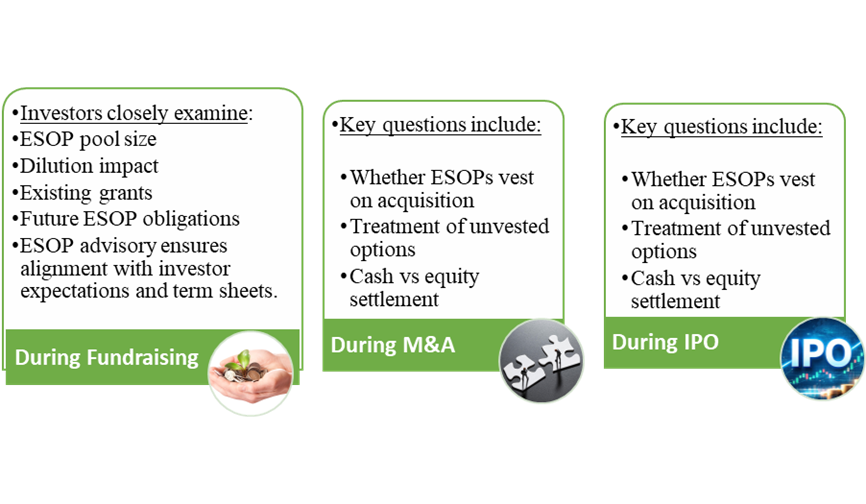
ESOPs During Funding, M&A, and IPO
Common ESOP Challenges and How Advisory Helps
| Challenge | Advisory Solution |
| Regulatory non-compliance | Legally compliant ESOP structuring |
| Employee confusion | Clear communication and education |
| Tax disputes | Proper tax planning and disclosure |
| Cap table complexity | Professional ESOP administration |
| Exit uncertainty | Pre-defined liquidity mechanisms |
Importance of Employee Communication
One of the most overlooked aspects of ESOPs is communication. Employees often:
- Overestimate immediate value
- Misunderstand vesting and taxes
- Expect guaranteed liquidity
ESOP advisory includes:
- Employee handbooks
- FAQs and workshops
- Clear grant communication
This builds trust and ensures ESOPs are seen as real value, not empty promises.
Governance and Compliance Best Practices
Effective ESOP management requires:
- Regular board oversight
- Periodic valuation updates
- Accurate disclosures in financial statements
- Audit-ready documentation
- Alignment with HR and finance teams
- Advisors act as long-term partners to ensure governance standards are maintained.
Why Professional ESOP Advisory Matters
ESOPs sit at the intersection of law, finance, taxation, HR, and strategy, handling them internally without expertise often leads to costly mistakes, Professional ESOP advisory helps companies:
- Design future-ready ESOP frameworks
- Stay compliant with evolving regulations
- Enhance employee satisfaction
- Protect shareholder interests
- Support long-term growth
Conclusion
ESOPs are not just compensation tools. They are strategic instruments that shape company culture, ownership mind set, and long-term success. A well-designed ESOP can transform employees into partners in growth. A poorly managed ESOP can create compliance risks and internal friction.
With structured ESOP advisory and proactive management, companies can unlock the true potential of equity-based incentives while maintaining transparency, compliance, and trust.