
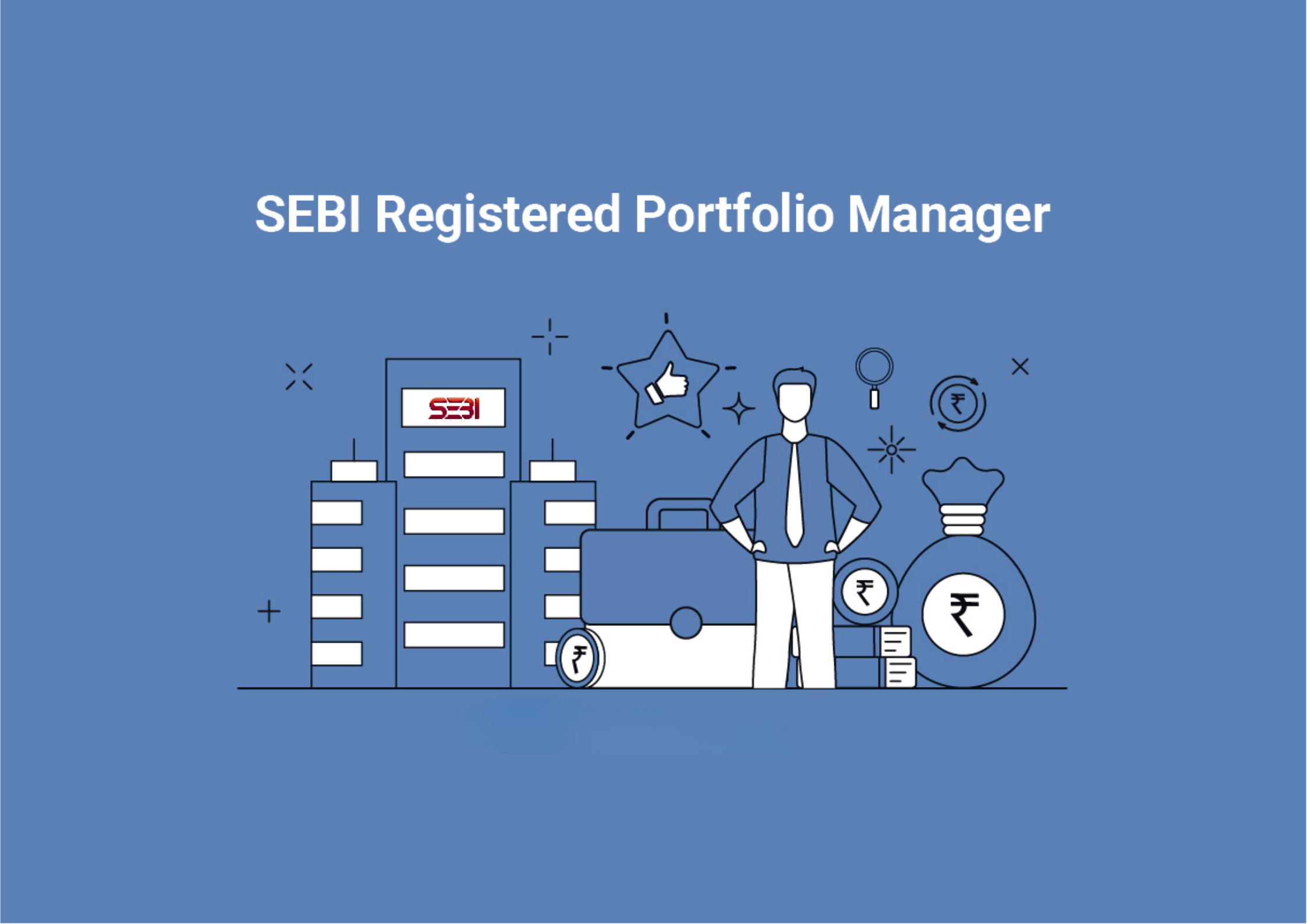
Portfolio Management Services (PMS) providers in India must obtain mandatory registration from the Securities and Exchange Board of India (SEBI) under the SEBI (Portfolio Managers) Regulations, 2020, to legally manage securities portfolios on a discretionary or non-discretionary basis for high-net-worth clients, ensuring investor protection through stringent financial, operational, and compliance standards. A portfolio manager acts as a fiduciary, offering personalized investment strategies, asset allocation, and risk management for clients investing at least ₹50 lakhs, distinguishing PMS from mutual funds by its customized, fee-based model (typically 1-2.5% management fee + performance incentives).
Who is a Portfolio Manager?
A portfolio manager is a body corporate who, pursuant to a contract or arrangement with a client, advises or directs or undertakes on behalf of the client (whether as a discretionary portfolio manager or otherwise), the management or administration of a portfolio of securities or the funds of the client. Every Portfolio Manager shall abide by the Code of Conduct as specified in Schedule III.
Types of Portfolio Management Services
Portfolio Management Services (PMS) in India, regulated by SEBI, are classified based on investment control and asset classes to suit diverse investor needs.
- PMS by Investment Control
- Discretionary PMS: Portfolio manager exercises full control, independently selecting strategies and investments to meet objectives without client input on specific decisions.
- Non-Discretionary PMS: Manager proposes investment ideas and handles trade execution, but clients approve each recommendation before implementation.
- Advisory PMS: Manager offers advice and recommendations only; clients retain full control over portfolio decisions and must execute trades themselves.
- PMS by Asset class
- Equity PMS: Focuses primarily on stocks, categorized by market capitalization (large-cap, mid-cap, small-cap) or strategies like value, growth, or thematic investing. Aims for long-term capital appreciation through equity market exposure with higher risk due to volatility.
- Debt PMS: Invests in fixed-income instruments such as bonds, government securities, and other debt products. Provides stable returns and lower risk, suitable for income generation and capital preservation.
- Hybrid PMS: Combines equities and debt in a balanced allocation to manage risk while pursuing growth and income. Offers moderate risk-return profile through diversified asset mix.
- Multi-Asset PMS: Diversifies across equities, debt, commodities, REITs, InvITs, and alternative assets. Seeks broader risk mitigation and enhanced returns via comprehensive portfolio allocation.
The Portfolio Managers Regulations by SEBI has enumerated the following general responsibilities on the portfolio managers:
In contrast to the non-discretionary portfolio manager, each client’s funds must be managed in accordance with the client’s instructions by the discretionary portfolio manager, who must manage them individually and independently in a manner that does not resemble that of a mutual fund.
- The portfolio manager shall not accept from the client, funds or securities worth less than fifty lakh rupees
- The minimum investment amount per client shall be applicable for new clients and fresh investments by existing clients Provided further that subject to appropriate disclosures in the disclosure document and the terms agreed between the client and the portfolio manager, the requirement of minimum investment amount per client shall not apply to an accredited investor
- The requirement of minimum investment amount per client shall not apply to the co-investment portfolio manager.
- With regard to the client’s funds, the portfolio manager must act as a fiduciary. The portfolio manager shall segregate each client’s holding in securities in separate accounts.
- The portfolio manager shall keep the funds of all clients in a separate account to be maintained by it in a Scheduled Commercial Bank.
- The portfolio manager shall transact in securities within the limitation placed by the client himself with regard to dealing in securities under the provisions of the Reserve Bank of India Act, 1934 (2 of 1934).
- The portfolio manager shall not derive any direct or indirect benefit out of client’s funds or securities.
- The portfolio manager is not allowed to borrow money or securities on the client’s behalf.
- Except as permitted by these regulations, the portfolio manager may not lend securities held on behalf of clients to a third party.
- The portfolio manager shall ensure proper and timely handling of complaints from his clients and take appropriate action immediately.
- The portfolio manager shall ensure that any person or entity involved in the distribution of its services is carrying out the distribution activities in compliance with these regulations and circulars issued thereunder from time to time.
The client can anticipate what kind of reports the portfolio manager will provide?
As agreed, upon in the contract, the portfolio manager is obligated to provide the client with a report every six months, but no longer than that, and whenever the client requests it. This report must include the following information:
- The composition and the value of the portfolio, description of security, number of securities, value of each security held in the portfolio, cash balance and aggregate value of the portfolio as on the date of report;
- The dates of all transactions that took place during the reporting period, as well as the specifics of purchases and sales;
- Beneficial interest received during that period in respect of interest, dividend, bonus shares, rights shares and debentures;
- The costs associated with managing the client’s portfolio; (e) details of risk foreseen by the portfolio manager and the risk relating to the securities recommended by the portfolio manager for investment or disinvestment.
This report may also be available on the website with restricted access to each client. In accordance with the client’s agreement, the portfolio manager must also provide the client with documents and information exclusive to portfolio management. The client has the right to inquire about the portfolio managers’ specific.
Process of Registration
After the Board determines that the applicant satisfies the requirements outlined in Regulation 6, it will notify the applicant and issue a certificate in Form B following receipt of the fees outlined in Schedule II. The application for obtaining the certificate needs to be made to SEBI along with non-refundable fee. The application needs to be made in Form A of Schedule I2. Form A is a very detailed form. It mostly needs the following information:
Organization Structure:
- Details of registration with SEBI or any other Govt. Regulatory body (Name of the regulator, Registration No., Registration start/end date, Registration status, details of action taken in the past (if any). List of major shareholders/partners of the Applicant (holding 5% or more voting rights)
- The objectives of the entity seeking registration, (Memorandum and Articles of Association/Partnership Deed to be enclosed). (Copy of Board Resolution to be enclosed)
- Date and Place of Incorporation (date/month/year/place/ROC Registration No.)
- Status of the Applicant (e.g. Limited Liability Partnership (LLP), for example Names of recognized stock exchanges to be provided if listed.) Organization Chart [separately showing functional responsibilities (names and designations) of portfolio management activities to be enclosed]
- Particulars of all Directors/Partners Name; Address; Qualification; Date of Appointment; DIN; PAN (Copy of PAN Card); Telephone No.; Mobile; Email; Experience (Entity name, designation, area of work, nature of work, experience (in years); other directorship/partnerships (entity name, date of appointment, No. of shares, percentage of shareholding)
- Key Management Personnel [Name; Address; Qualification; Date of Appointment; DIN; PAN (Copy of PAN Card); Telephone No.; Mobile; Email; experience (Entity name, designation, area of work, nature of work, experience (in years); other directorship details (name of entity, date of appointment, No. of shares, percentage of shareholding)
- Particulars of Promoters (Type (Individual/Corporate); Name, PAN, Address, Telephone, Mobile, Email)
- Particulars of Compliance Officer (Name, PAN (Copy of PAN card), Address, Qualification, Date of appointment, Address, Experience (company name, designation, area of work, nature of work, experience (in years).
- Particulars of Principal Officer [Name; Qualification; Date of Appointment; PAN (Copy of PAN Card); Certification details (date of test, result, percentage, certificate No., validity from (date) and validity till date)
- Number of employees and number of employees for Portfolio Management services
- Name and activities of associate companies/entities
Particulars of the applicants
- Name of the Applicant
- PAN
- Registered office’s address Address for Correspondence
- Address – Principal place of business (Where PMS activity shall be carried out)
- Information about the branch offices from which the PMS activity will be carried out, such as their addresses, names, phone numbers, and email addresses, among other things.
Buildings and Facilities
- Principal Place of Business and for branch office.
- Office Space.
- Office Supplies Fixtures and Furniture Communication Resources Capacity for Data Processing: Internal and External Computer facility: hardware and software.
- Details of the Business Continuity Plan and Disaster Recovery Setup.
Other details:
- Experience in financial services rendered: details of activity, etc.,
- Additional Information: The Draft Disclosure Document and the Draft Agreement with the Client are both to be provided. Custodian information (name, address, SEBI registration number, appointment date) Specifics regarding registration with additional regulatory bodies.
- Plan for a three-year business: History, major events, and current activities proposed business plan and methods for implementing it estimated.
- Profitability for the Next Three Years (Targets, Methods for Achieving Goals, and Resulting Income).
- Financial Information: Capital Structure, Paid-up capital and Free Reserves (excluding revaluation reserves) for the previous year, the current year, and the previous year Net worth of Applicant (Net worth certificate not older than 3 months from the date of application to be enclosed).
- Information regarding: Details of all settled and pending disputes of previous 3 years, indictment of involvement in any economic offences in the last three years, any additional information deemed pertinent to the nature of the company’s services, details of Membership with the recognized Stock Exchanges.
- Business Information: Indicate type of activity carried on/proposed to be carried on, mention the facilities for making portfolio investment decisions, Details of risk profiling procedure to be followed by the Portfolio Manager,
- Specifics of the Portfolio Manager’s procedure for resolving disputes and grievances. Provide list of approved share brokers through whom orders shall be placed, involved for Portfolio Management activities and state whether any of them were suspended/had defaulted with any Stock Exchange authority. Describe Accounting system followed/to be followed for Portfolio Management Services.
Grant of Certificate
Once approved, SEBI issues a Certificate of Registration, valid for a set period (e.g., 3 years)
Renewal Fees and Compliance Requirements
- The application fee is one lakh, and the registration fee is ten lakhs.
- There are also annual compliance fees, and the registration fee is five lakhs every three years.
- In order to avoid suspension or cancellation, portfolio managers are required to separate client funds, disclose fees and risks upfront, keep 3% of their net worth liquid, and report grievances via SCORES.
- Transparency was increased and risk profiling and performance benchmarking were mandated as part of reforms after 2020.