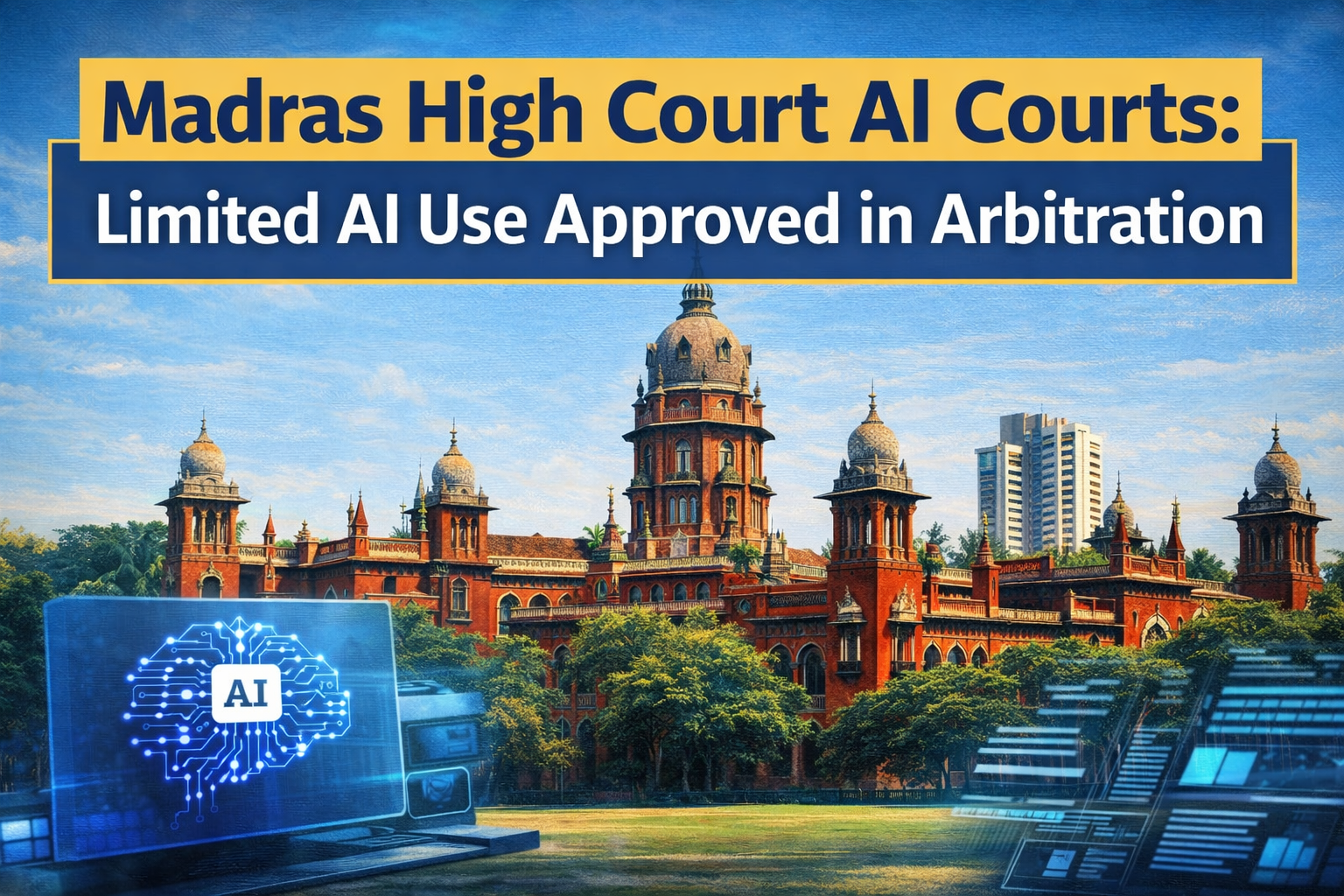
Madras High Court AI courts entered a new phase of judicial innovation after the Court permitted limited use of an artificial intelligence-assisted system strictly for record management, while firmly excluding any role in judicial decision-making.
In a common order dated January 28, 2026, Justice N Anand Venkatesh approved a pilot use of an AI-based tool titled “Superlaw Courts” in a batch of arbitration-related matters between Gammon-OJSC Mosmetrostroy JV and Chennai Metro Rail Limited (Gammon v. Chennai Metro Rail Corporation).
Madras High Court AI Courts Approve Controlled AI Trial
The High Court made it clear that the AI system would function strictly as a record-bound assistant and not as an adjudicatory tool. Describing its role, the Court noted that Superlaw Courts essentially operates as a highly organised digital record assistant—preparing papers, creating reliable finding aids, and presenting relevant excerpts from the case record when queried.
Crucially, the Court emphasised that the system does not:
- draw legal inferences,
- assess credibility of evidence,
- interpret intent, or
- express legal opinions.
All judicial reasoning, interpretation, and final adjudication would remain solely with the judge.
Open Court Demonstration and Safeguards
The AI tool was demonstrated in open court, with the participation of counsel for both parties as well as the presiding judge. A detailed technical note explaining the system’s functioning was circulated and formally placed on record.
According to the note, the system:
- operates only on documents filed in the specific case,
- does not access external databases or the internet,
- does not generate information beyond the existing record, and
- explicitly states when requested material is not available, instead of speculating or filling gaps.
Digital Workspace for Voluminous Records
Justice Venkatesh observed that the system creates a digital workspace comparable to a sealed record room. It converts scanned documents into searchable text, groups related materials, removes duplicates, and divides records into logically coherent excerpts rather than mechanical page splits.
The Court noted that this approach is intended to significantly reduce the time and effort involved in navigating extensive arbitral records, particularly in complex commercial disputes.
Transparency and Limited Duration of AI Use
To maintain transparency, the Court directed that a separate access link be provided to log and display every interaction between the AI system and the counsel or the Court. This would allow any reader of the order to verify the extent to which the AI tool was consulted during the proceedings.
The Court further directed that a draft order capturing facts, pleadings, evidence, and rival submissions may be prepared with AI assistance and circulated to both sides for verification. However, once this verification stage is completed, reliance on the AI system would “come to an end,” and the final adjudication would be undertaken entirely by the judge.
Trial Period and Next Hearing
Counsel appearing for both parties agreed to work with the AI system for a one-week trial period and report back on its effectiveness. The matters have been listed for final hearing from February 12, 2026, with a detailed schedule fixed for completion of submissions and reply arguments.
A Cautious Step Towards Courtroom Technology
The order reflects a cautious but forward-looking approach by the Madras High Court, embracing technology to improve efficiency and case management, while firmly safeguarding the independence of judicial reasoning and the core principles of adjudication.