


The Government of India implemented four Labour Codes on November 21, 2025, consolidating 29 outdated laws into modern frameworks
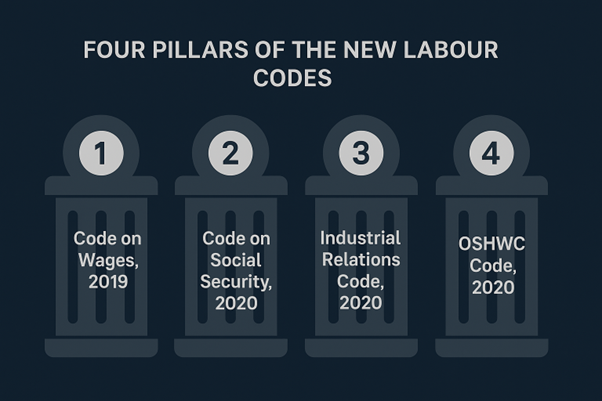
Code on Wages, 2019
“The Code on Wages expands the statutory right to minimum wages for all employees, ensuring wage protection across India.” – Ministry of Labour
This code merges four prior laws, ensuring universal minimum wages with a national floor set by the central government, revised every five years based on skill and region. Employers must pay overtime at twice the normal rate and prohibit gender-based wage discrimination, applying to all workers without wage ceilings. Timely payments are mandatory, with inspectors acting as facilitators rather than just enforcers.
Industrial Relations Code, 2020
“Industrial harmony is the foundation of economic growth. This Code empowers workers while enabling businesses to thrive.” – Government of India
The code simplifies trade unions, standing orders, and dispute resolution from three older acts, raising layoff/retrenchment thresholds from 100 to 300 workers. Fixed-term employees gain parity with permanents, including gratuity after one year, and a re-skilling fund supports retrenched workers. Strikes require 14-day notice, and women get proportional representation in grievance committees.
Code on Social Security, 2020
“The Social Security Code is a step towards inclusive welfare, ensuring no worker is left behind.” – Labour Ministry
Consolidating nine laws, it extends ESIC pan-India, mandatory for hazardous units even with one worker, and voluntary for smaller firms. Gig and platform workers receive benefits via aggregator contributions of 1-2% turnover, with a dedicated fund from penalties. Gratuity applies after one year for fixed-term staff, and commuting accidents qualify for compensation.
Occupational Safety, Health and Working Conditions Code, 2020
“Worker safety is non-negotiable. The OSHWC Code ensures dignity and protection at every workplace.” – Prime Minister of India
Amalgamating 13 acts, it mandates free annual health check-ups for workers over 40, caps hours at 8/day and 48/week with consent-based overtime at double pay. Women can work night shifts and hazardous jobs with safety measures; contract labour threshold rises to 50 workers with all-India licenses. Single registration and returns ease compliance for factories (20+ with power, 40+ without).
Why this Reform Matters?
India’s labour environment had long been governed by a patchwork of archaic laws, many dating to colonial times — designed for a very different industrial and economic era.
Rapid structural developments, such as the expansion of services, the gig economy, contract-based labour, digital labour, and platform-based labour, were making it difficult for employers to comply with the outdated regulations, which sometimes left workers in unprotected or informal segments. The revised Labor Codes make an effort to address this discrepancy.
This rationalized framework could be crucial in determining the future of labour, employer practices, social security coverage, and industrial growth in a nation with a vast and diverse workforce that includes formal, informal, organized, unorganized, gig, urban, and rural workers.
What It Means — For Workers & For Employers
Potential Benefits:
- Formal recognition and protection are provided to workers, including mandatory appointment letters, timely wages, a minimum wage floor, social security, health and safety benefits, and enhanced rights for gig, contract, fixed-term, and platform workers.
- India’s uniformity includes less regional and legal distortions, easier compliance standards, more precise definitions, social security mobility, and enhanced openness.
- Flexibility in employment models: acknowledging work-from-home and fixed-term employment may open up new opportunities, particularly in service and gig-based industries.
- The formalization of the gig and unorganized economy is a significant change considering the size of India’s informal labour sector.
Conclusion
“India has hit refresh on its labour laws—ushering in reforms that promise both justice and growth.”
Although the central codes are already in effect, state-level regulations and notifications will determine how they are actually enforced.
States are required to publish comprehensive regulations, including those pertaining to social security programs, working hours, safety standards, inspection procedures, grievance resolution, and compliance methods. The actual ground-level impact will depend on the speed and efficacy of these warnings. The Four Labour Codes represent a historic transformation in India’s labour landscape. By balancing worker welfare with industrial competitiveness, they pave the way for a transparent, inclusive, and future-ready economy.