
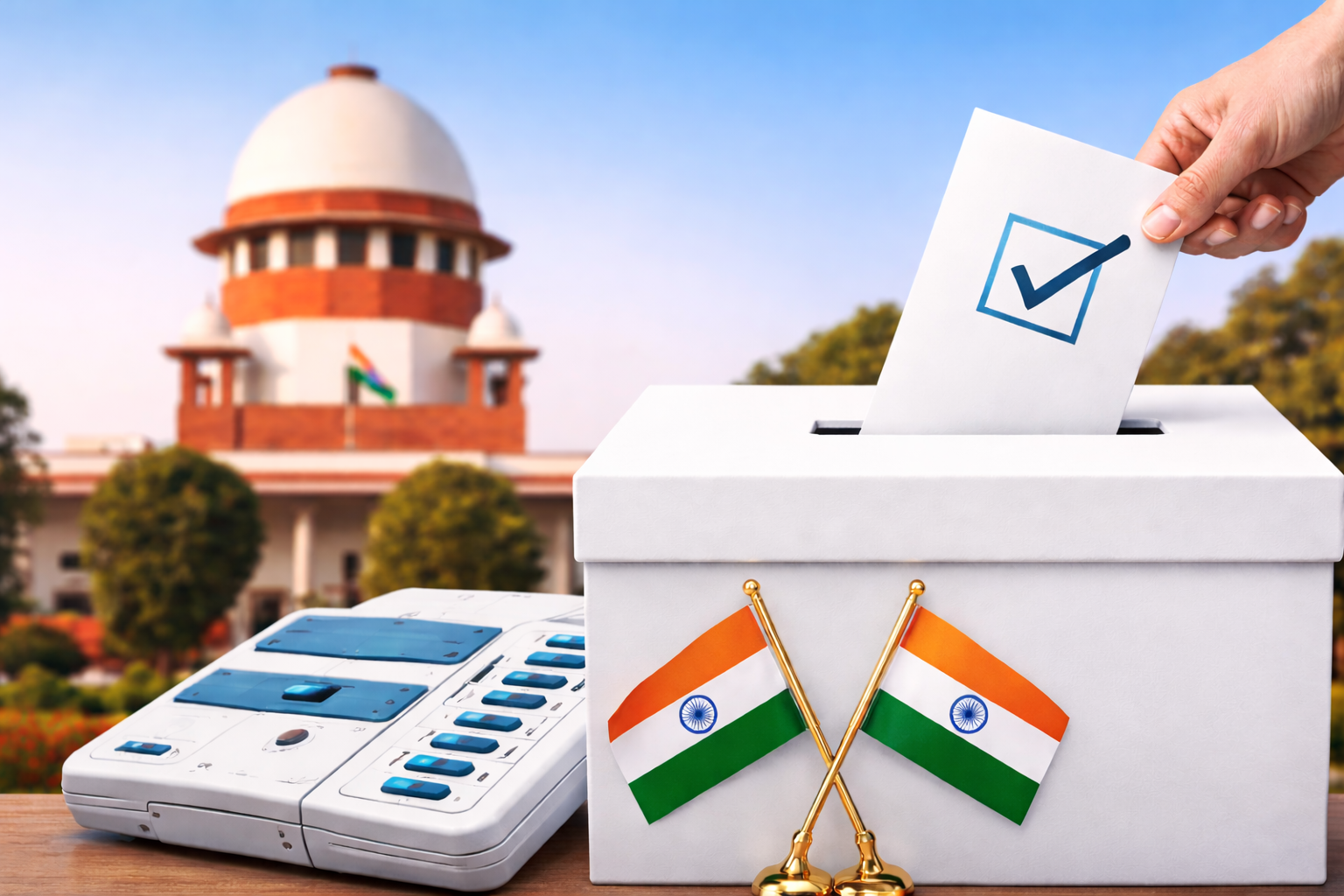
The Supreme Court of India has ruled that voting cannot be made mandatory, refusing to entertain a Public Interest Litigation (PIL) seeking penalties against citizens who do not participate in elections. The judgment on Supreme Court on Compulsory Voting reinforces that electoral participation is a democratic right, not a legal obligation.
Supreme Court on Compulsory Voting: Background of the Case
The PIL, filed by Ajay Goel, sought directions to impose consequences on non-voters, including the denial of government benefits. The petitioner argued that such measures would enhance voter participation and strengthen democratic governance.
However, the Supreme Court found the proposal impractical and beyond judicial intervention, emphasizing that encouraging electoral participation must be achieved through awareness rather than coercion.
Compulsory Voting: Bench and Observations
The matter was heard by a Bench comprising:
- Chief Justice Surya Kant
- Justice Joymalya Bagchi
- Justice Vipul M Pancholi
The Court expressed strong reservations about enforcing compulsory voting, noting the logistical and socio-economic challenges in a diverse nation like India.
It emphasized that:
- Voting is a constitutional right, not a mandatory duty.
- Citizens may abstain due to genuine constraints such as employment or financial hardship.
- Coercive measures would undermine democratic freedoms.
Supreme Court on Compulsory Voting and Democratic Principles
The ruling on Supreme Court on Compulsory Voting underscores the importance of voluntary participation in elections. The Bench observed that India’s democracy has thrived on trust in its citizens for over 75 years.
The Court clarified that:
- Awareness campaigns are more effective than penalties.
- Denying government benefits to non-voters would be unconstitutional.
- Compulsory voting policies fall within the domain of the legislature and executive.
Policy Matters Fall Within Legislative Domain
The Supreme Court reiterated that decisions regarding electoral reforms must be taken by Parliament and the government. The judiciary cannot mandate compulsory voting or impose punitive consequences for non-participation.
For official information on voting rights, refer to:
- 🔗 Election Commission of India – https://eci.gov.in
- 🔗 Constitution of India – https://legislative.gov.in
These authoritative resources provide insights into electoral laws and democratic governance in India.
Legal and Constitutional Significance
This ruling holds substantial importance for India’s democratic and constitutional framework:
- Reaffirms Democratic Freedom: Voting remains a voluntary right rather than a compulsory duty.
- Upholds Constitutional Values: Protects individual liberty and freedom of choice.
- Maintains Judicial Restraint: Reinforces the separation of powers by leaving policy matters to lawmakers.
- Encourages Electoral Awareness: Highlights the need for voter education instead of coercion.
- Protects Socio-Economic Equity: Recognizes the challenges faced by economically disadvantaged citizens.
Conclusion
The Supreme Court’s decision serves as a significant reminder that democracy thrives on participation driven by awareness and free will, not compulsion. By rejecting the plea for compulsory voting, the Court has upheld constitutional principles while emphasizing the importance of informed and voluntary civic engagement.